Jacen's Blog
I Really Wanted To Love This... - Anbernic RG DS Review
December 23, 2025
This review contains affiliate links to some of the products mentioned.
I've said it many times before: my Nintendo 2DS XL is still my favorite gaming device that I've ever owned. So, when I saw the Anbernic RG DS, I knew I needed to try it out. Dual-screen handhelds have always been outrageously expensive, so having one in the budget tier was an exciting prospect. However, the initial reviews weren't very favorable. Still, I held on to the hope that it would be a compelling budget option to compete with AYANEO and AYN. Now that I have it in my hands, is it as bad as people make it sound, or is it a worthwhile purchase?
The Unboxing
In the box, along with the RG DS itself, you'll find a USB-C-to-A cable, Anbernic's usual screen protector, a wrist strap, and a double-sided capacitive stylus. If you choose to order an microSD card, you'll find that included as well. I've complained countless times on this site about the USB-C-to-A cable rather than a C-to-C, so I'll just say the complaint continues to apply.
I'm also not a big fan of the stylus. While I appreciate the inclusion, since even more expensive handhelds don't bother including one at all, the main touchpoint of the stylus is the standard mushy rubber, which isn't very accurate or satisfying to use, and even the precision side of the stylus doesn't feel great on the screen. Maybe one day a handheld company will create a stylus that feels more satisfying to use for DS emulation, but this one definitely isn't it.
The RG DS is 16 x 9 x 2 cm in size and weighs in at 321 grams. I saw a couple of complaints about the size, but it's extremely close to the size of the 2DS XL, making it very pocketable.
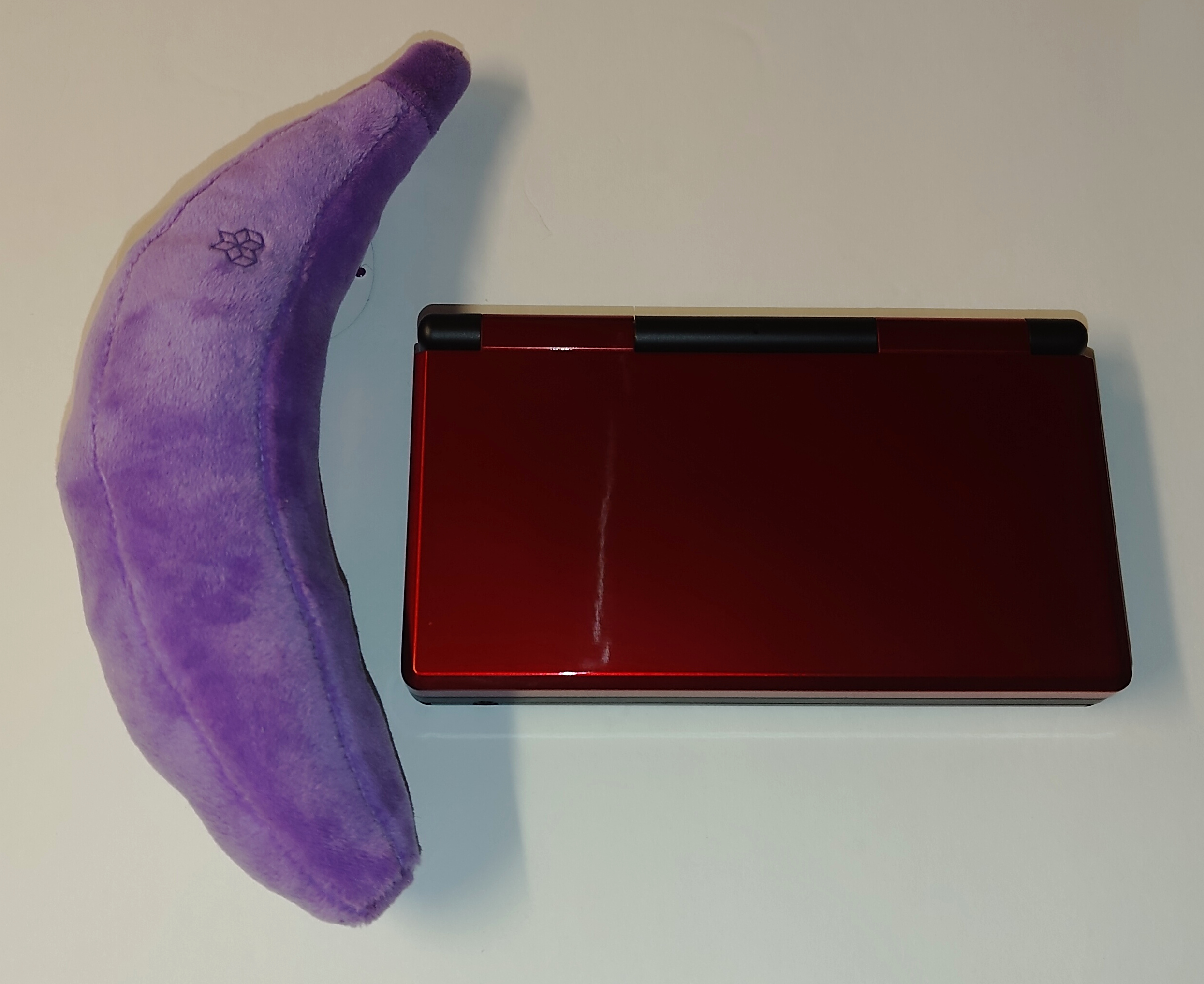
Anbernic provides three different color options for the RG DS: black and red, turquoise, and white. The first gaming device I ever owned was a red DS Lite, so I chose the black and red option for the sake of nostalgia, and the colors are definitely quite true to the original DS.
The Hardware
The main selling point of the RG DS is, of course, the dual screens and clamshell form factor. I've praised clamshell handhelds in the past, and I'm a fan of the extra protection they give the screens and joysticks. Notably, both screens are touch-sensitive, so you can easily run apps on both. As for the hinge, it's very stiff and doesn't lock into place in any position. This has the advantage of letting you position the screens at whatever angle you prefer, with the stiff hinge holding in place very well. It does have the downside of making the device take a fair bit of force to open compared to the DS or 3DS families. I'm also a fan of the screens visually. The colors are nice and vibrant compared to the original DS families (probably helped by the fact that they use capacitive touch rather than resistive).
The controls are about what you would expect from a modern gaming device, with four face buttons positioned in the standard Nintendo layout, a d-pad, two recessed analog sticks, two sets of shoulder buttons, and start and select buttons. There's also a combined back/home button for Android operations and Anbernic's signature function button that, like with the RG Slide, cannot actually be remapped for any useful functions. Short-pressing the button switches the controller focus across screens, while long-pressing starts the RG Launcher, giving you a more controller-friendly interface for launching games. I think it would have been a much better use of space to split "home" and "back" into separate buttons and remove the function button entirely.
The buttons all use tactile switches, which is good news if you're a fan of clicky buttons. The shoulder buttons in particular are extremely loud when pressed. The analog sticks are on the stiffer side, if that's something you have a preference for. Due to their size and the convex caps, I noticed it was easy to slip off them if you aren't hooking your thumb around the edges of the stick.
Along the right side of the RG DS are the volume buttons and power button. The three buttons are all a bit recessed, and I found the volume buttons to be a little difficult to find by feel. This is a very minor nitpick, but it's still a bit annoying, especially with the sleep button so dangerously close to the volume buttons.
As for I/O, the RG DS has two USB-C ports (only one of which can be used for charging), a microSD card slot, and a 3.5 mm headphone jack. The USB-Cs are a bit strange. One is labeled DC, while the other is OTG, but the DC port is perfectly capable of transferring data when connected to a computer. Also, neither port supports DisplayPort alt mode, so wired video output will not work on the RG DS if that's something you care about.
Sound is handled by two front-firing speakers on either side of the top screen. They sound about as good as the speakers from the original DS. Like with most budget handhelds, they're certainly adequate for retro gaming, but nothing particularly impressive. This would be the part where I say, "You'll want to use headphones," but you actually won't. The headphone jack seems to have some kind of interference issue, causing an extremely loud electronic hum. I'm not sure how Anbernic managed to screw up the headphone jack so badly, but it's practically unusable. This hum also comes through the speakers, although I found that more tolerable than the headphones.
Under the hood, the engine of the RG DS is the Rockchip RK3568, with a quad-core Cortex-A55 CPU and an ARM Mali-G52 GPU, fed by 3 GB of RAM. The internal storage is 32 GB, and you can add up to 2 TB of additional storage via the microSD card slot. All the internals are accessible via four hex screws on the bottom. The RG DS loses points for hex screws rather than Phillips, and the bottom panel was a bit difficult for me to get off, even with a plastic pry tool, but it otherwise seems pretty easy to repair if needed.
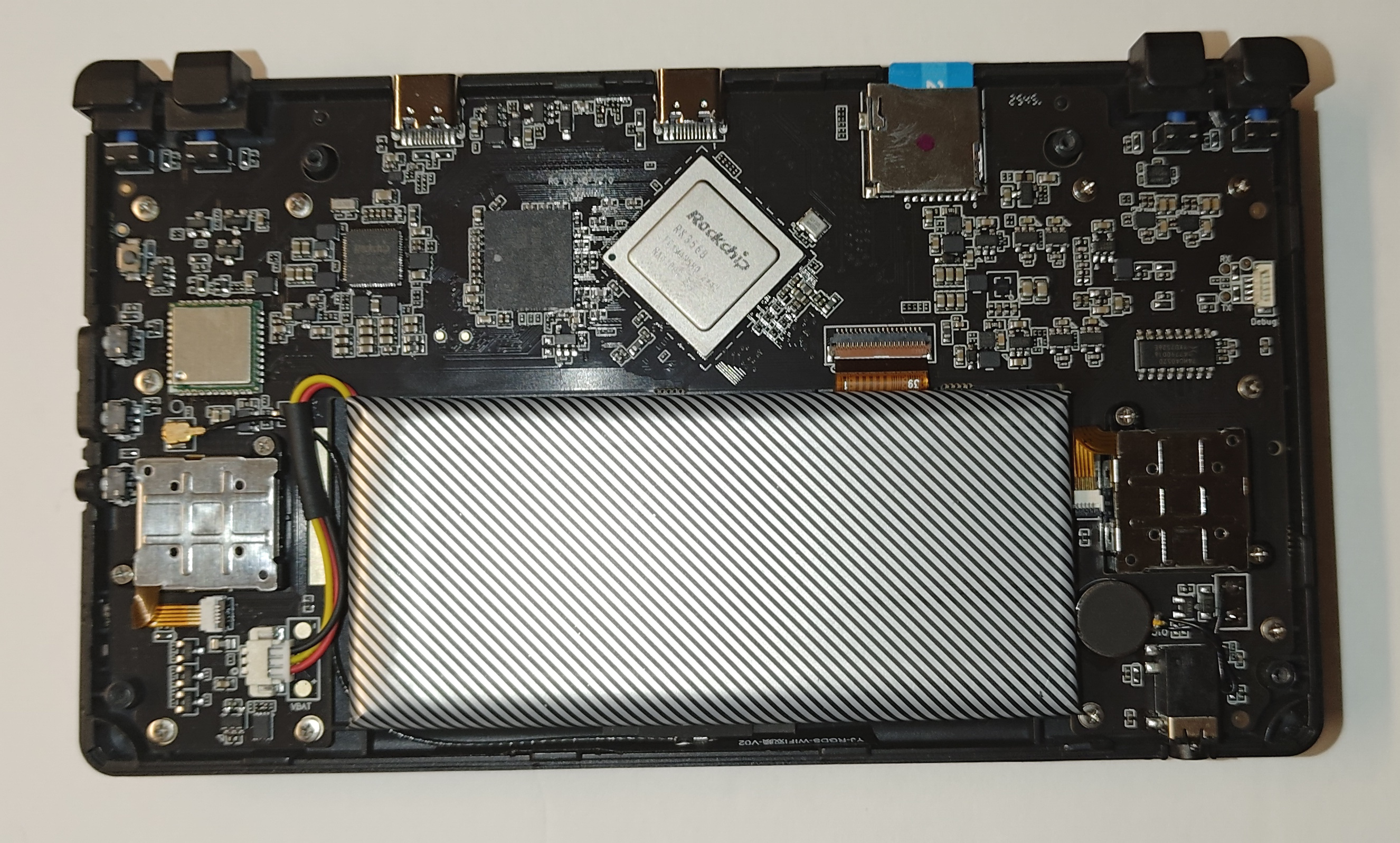
The device is powered by a 4000 mAh battery. Anbernic claims it will last around 6 hours, which seems pretty close to accurate based on my testing. Notably, I had some issues with the idle battery life, but I think that was more of a software issue, so I'll address that a little later.
The Software
The stock OS for the RG DS is based on Android 14. Unlike the RG Slide, the other Android-based Anbernic handheld I've tried, the Google Play Store and Google Play Services are not included, so you'll need to sideload any additional apps you might want to use.
DS emulation is, of course, the primary use case for the RG DS, and it handles it pretty well. DraStic is an extremely mature DS emulator, even if it's no longer in development, and it runs smoothly even on low-power devices, so the RG DS's hardware is more than sufficient for that purpose. Anbernic did make the bizarre decision to enable DraStic's lcd1x visual filter for some reason. While it does make games look closer to how they look on original DS hardware, the screen-door effect was too much for me. For some reason, turning the filter off while a game is running doesn't affect the top screen, so you'll need to make sure you adjust your video settings before you load your game.
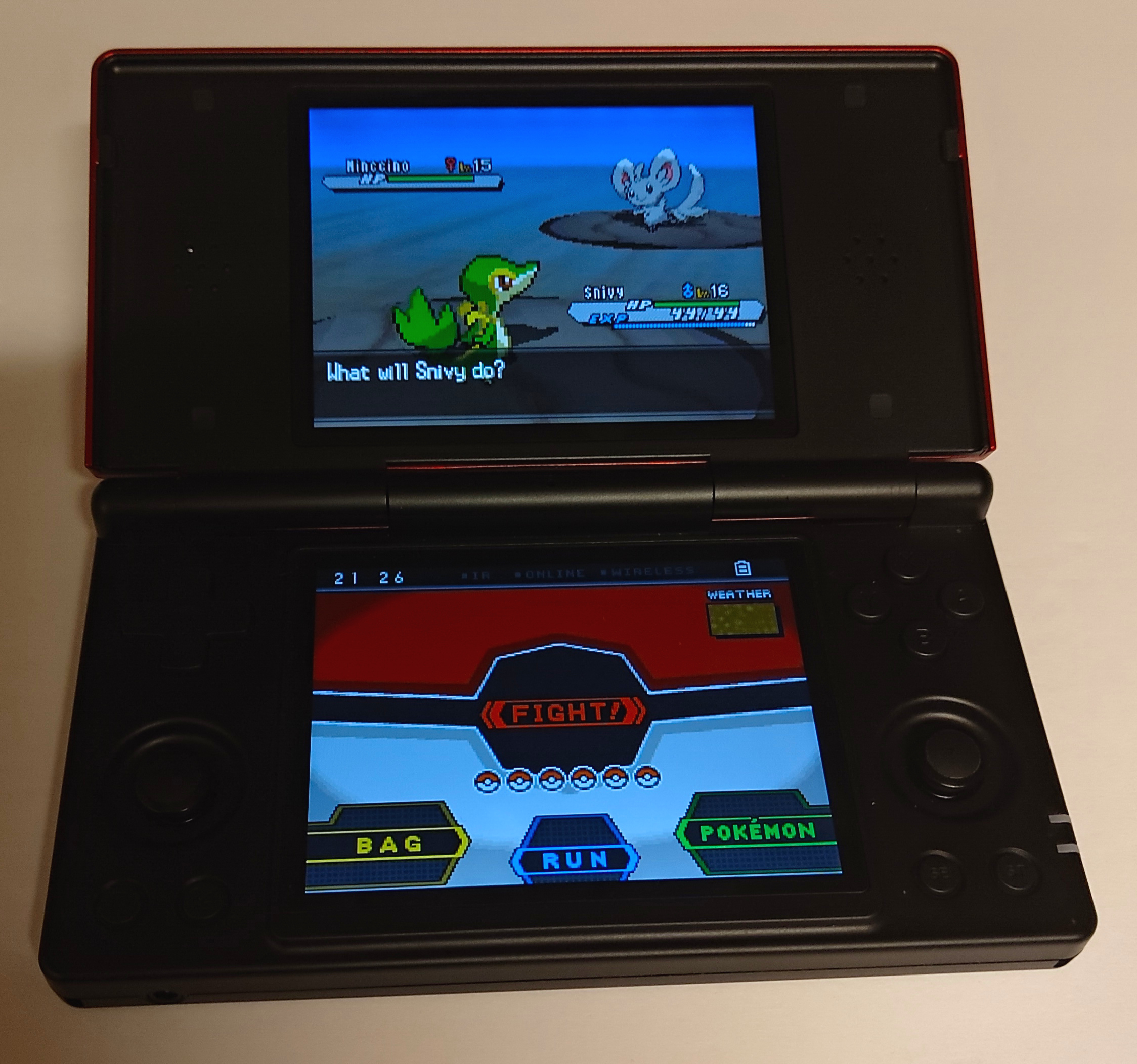
Navigating the Android OS to get to the games is a bit less smooth. The SoC really shows its weaknesses when you try to launch apps. DraStic seems to struggle with loading the ROM list, with Android detecting the app as "not responding" pretty frequently. Things seem to stabilize once you get into the game, but it's still a struggle to get there.
One common complaint that I saw was the inability to run melonDS via RetroArch due to the underpowered SoC. Personally, I consider that to be more of a failure on melonDS rather than the RG DS. DS emulation on Android has been a very solved problem for years; DraStic is not the only emulator that can run well on underpowered hardware. It's clear to me that melonDS just lacks the polish and optimization that DraStic has, as proven by the fact that DraStic runs games on the RG DS with few to no issues.
One issue that I did run into was that idle battery life issue I mentioned earlier. On my first day after receiving the RG DS, I charged it to full, unplugged it, and went to sleep. When I woke up the next morning, I pulled it out to start my testing only to find it completely dead. When I tried to do my idle battery life benchmark, I noticed the RG DS was very warm to the touch and the battery seemed to be draining faster than expected. In both of these instances, DraStic was running in the foreground, and sleep was initiated by closing the device. I haven't been able to recreate the sleep issue since my first day, so I'm not entirely sure what the cause was.
Beyond just DS emulation, the RG DS is perfectly capable of emulating other systems. Even something as advanced as running 3DS games with Azahar is within the realm of what I would call "playable", albeit with some severe slowdown in more demanding games.
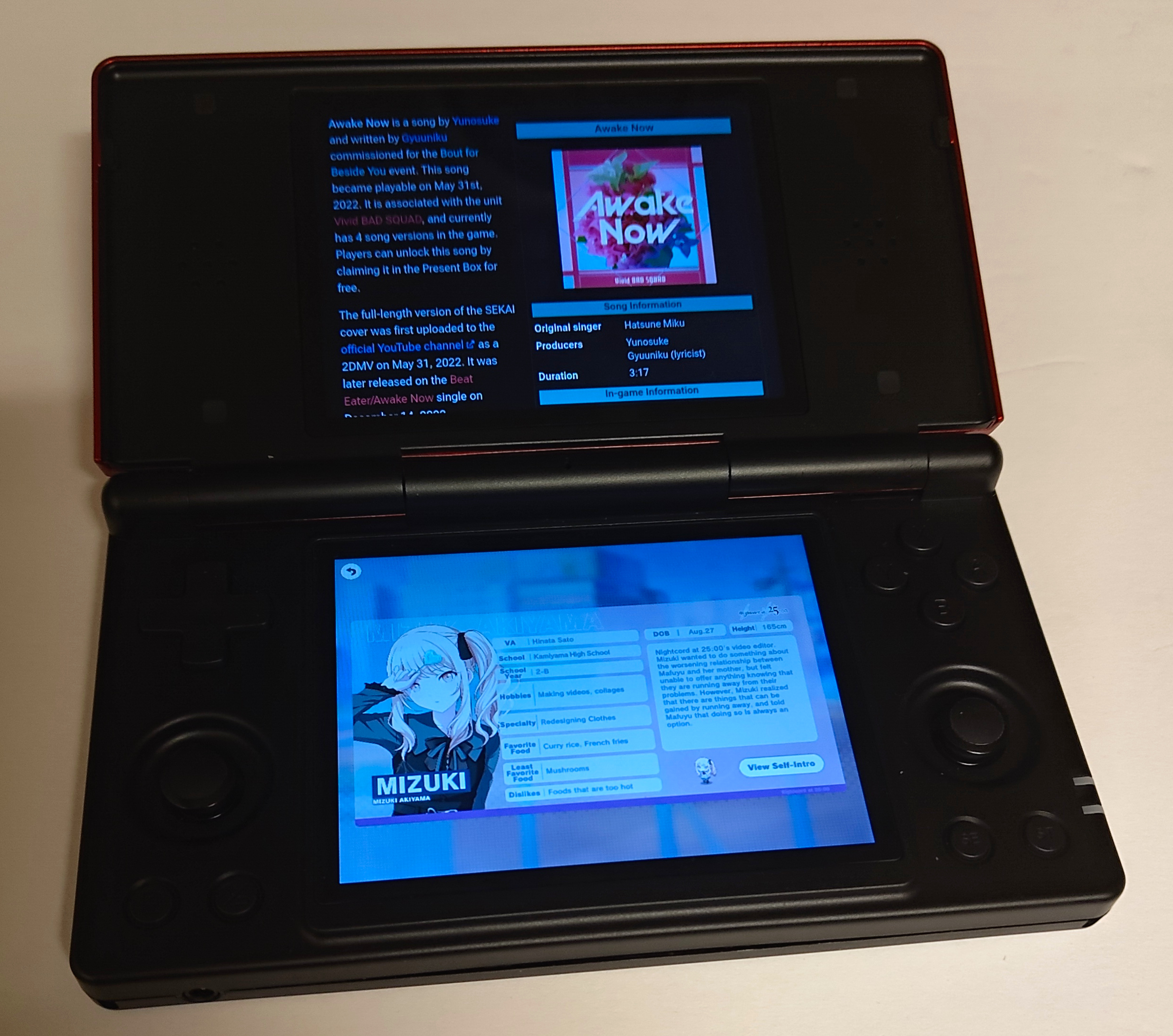
Despite the lack of the Play Store and the generally underpowered hardware, I tried to run the RG DS through a small test suite of casual games. Of my usual games, Honkai: Star Rail was too big to fit on the RG DS's storage, and Blue Archive wouldn't run without Google Play Services. Performance in Project Sekai was pretty poor, both in terms of frame rate and input latency. I would describe it as being on the lower extreme of what would be considered "playable".
Conclusion
Ultimately, the RG DS stands in a class of its own, with no other real competitors to speak of. While other dual-screen handhelds do exist, such as the AYANEO Pocket DS and the AYN Thor, they both cost nearly four times the price of the RG DS. Anbernic has positioned this as a budget handheld, and nothing else even comes close to matching the RG DS's cost.
With that said, you're making many compromises with the RG DS between the lackluster Android performance, the sound issues, and more. However, if all you want to do is play DS games and you're willing to put up with the annoyances, you could certainly do much worse than this device. It's not the greatest handheld in the world, but it's not as bad as the Internet would have you believe, especially at a sub-$100 USD price point.