Jacen's Rants
A Compressed Qualifying - IndyCar 2026 Round 7 Qualifying Recap
May 17, 2026
With how big of a performance qualifying is for the Indy 500, it seemed reasonable to make a dedicated post for it. Unfortunately, the weather took away a lot of the spectacle, limiting us to just one run per car in the first round. Still, let's see what big storylines we can find going into the next week.
CGR's Triple Threat
It was a good day for Chip Ganassi Racing, with all three cars making it into the Fast 12. Alex Palou didn't have the most impressive run in Q1 with a 4-lap average speed of 231.2 MPH, but improved significantly on the second run, with a 231.6 MPH. He then put up a monster final run, posting a final 4-lap average of 232.2 MPH to claim his second Indy 500 pole. It's been a while since we visited the question of "How do you beat Alex Palou?" and it's a question the rest of the field will be mulling over for the rest of the week.
Scott Dixon, meanwhile, had a bit of a rough second run, dropping from a 231.4 MPH 4-lap average to 230.3 MPH, ultimately ending up 11th. He and the team didn't seem to really have any idea why the car dropped off so much, but they seem to have a good car in race trim, and 11th isn't the worst starting spot.
Kyffin Simpson was a surprise appearance, with a 231.0 MPH 4-lap average, and he ended up out-qualifying his veteran teammate, Dixon. Ultimately he ended up just short of the fight for pole, qualifying in 7th at 230.8 MPH, but it was still an impressive performance. Kyffin seems to be slowly figuring out qualifying, and I'm hoping the race results will start to follow.
A Flex From Felix
Felix Rosenqvist put up a monster qualifying lap in the first round, posting a 4-lap average of 232.5 MPH. He backed it up in the Fast 12 with a 232.0 MPH. Unfortunately, the third run dropped off to a 231.3 MPH, relegating him to 4th place. Ultimately, it was still an impressive run that hopefully he can convert into a quality Indy 500 finish.
Rookie Phenom?
In the first couple of races, Dennis Hauger had looked like the most impressive of the rookies. Today at the 500, Caio Collet proved that we shouldn't count him out. He's improved rapidly throughout the course of the season, and he drove his way into the Fast 12 with a run at 231.4 MPH. He wasn't super consistent on his second run, but ended up with a 230.5 MPH 4-lap average and a 10th-place starting position. I'll admit that I discounted AJ Foyt as a team more than I should have at the start of the year. It seems like we might have a legitimate fight for Rookie of the Year at the end of the season.
Mixed Results for Team Penske
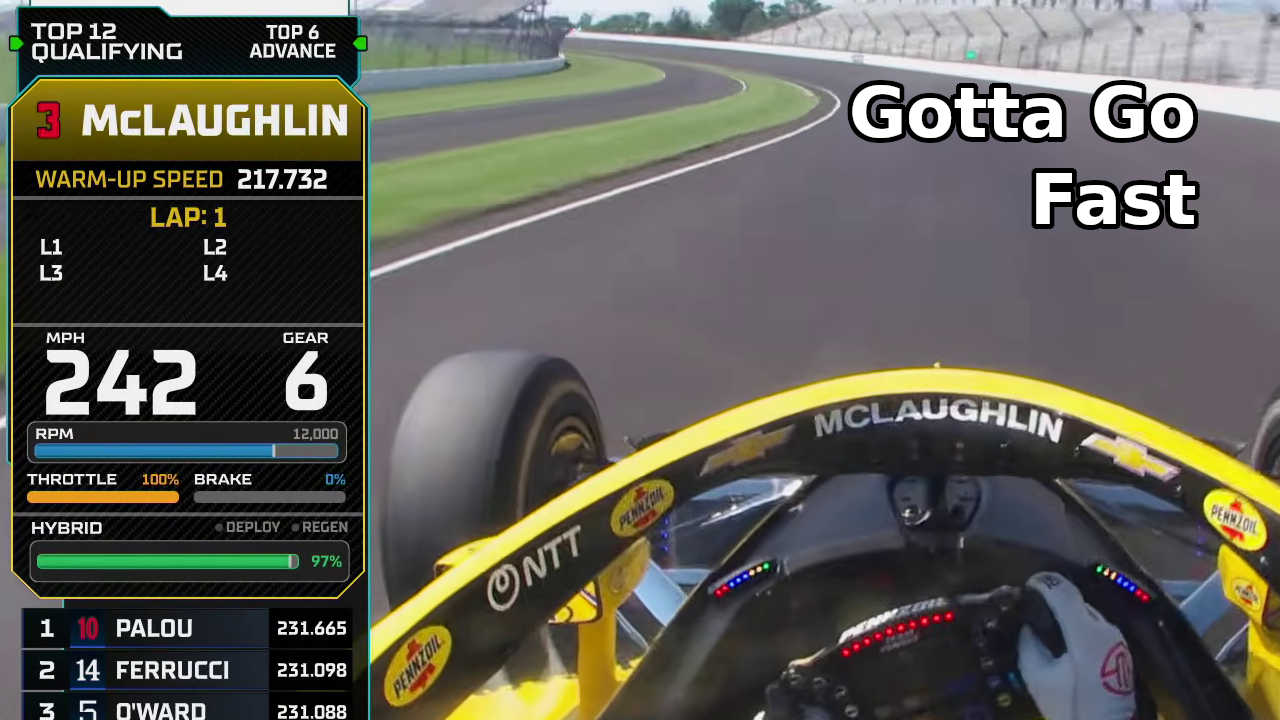
Penske put two cars into the Fast 12. Scott McLaughlin, after a 231.6 MPH 4-lap average in Q1, ended up 9th after a heroic run to avoid crashing the car in rough conditions, with a massive tailwind going into turn 3. David Malukas ran a 231.8 MPH in Q1 and a 231.4 MPH in Q2. He ultimately put the car on the front row with a 231.8 MPH run in Q3, putting him 3rd in his first Indy 500 for Team Penske.
Josef Newgarden, meanwhile, showed no pace, qualifying back in 24th with a 4-lap average of 230.1 MPH. He had been strong on Friday, so it was surprising to see the 2-time 500 winner completely miss the top 12. He's made runs through the field in the past, so we'll see what he has for next week.
McLaren Woes
Ryan Hunter-Reay, driving a one-off entry for Arrow McLaren, was pretty slow on Friday and not impressive in morning warm-up. He qualified 23rd with a 4-lap average of 230.2 MPH. RHR mentioned that the balance felt good, but the car just wasn't fast, which sounds to me like the car wasn't trimmed enough. Any adjustment that increases downforce will also increase drag, and you want your drag to be as low as possible on a superspeedway. Obviously you still need enough handling to complete the run, but I have to wonder if the setup could have been trimmed just a bit more.
Christian Lundgaard, fresh off his win at the Indy GP, qualified back in 19th, and Noal Siegel found himself starting 21st. Pato O'Ward, at least, put the car in the Fast 6, with a 231.2 MPH in Q1 and a 231.0 MPH in Q2, ultimately qualifying 6th with a 4-lap average of 230.4 MPH. Having one car up front is good, but it's still not the result that McLaren would like to have across the team.
Andretti's Missing Something
When the boost was turned up for Fast Friday, I had some concerns about Andretti's performance, or lack thereof. The concerns were shared by the team, and they came to fruition in qualifying.
Will Power didn't have a particularly impressive run, qualifying 20th with a 4-lap average of MPH. Marcus Ericsson ran a respectable first lap of 231.4 MPH but had a big lift that caused a big dropoff that he was never able to fully recover from, resulting in an 18th-place start and a 4-lap average of 230.6 MPH. Kyle Kirkwood found himself well off the pace, back in 26th with a 4-lap average of 229.6 MPH.
The cars had race pace during practice, but it seems like something was missing in the higher boost mode. We'll see what they have for race pace.
Rahal's Achilles' Heel
In 2023 and 2024, Graham Rahal found himself in the last row shootout, including actually being bumped from the 500 in 2023. In 2025, he barely scraped by, qualifying 30th before the Penske penalties were assessed. In 2026, he qualified 30th again with a 4-lap average of 229.0 MPH.
Elsewhere on the team, Mick Schumacher qualified 28th with a 4-lap average of 229.4. Louis Foster managed to make it into the 230s, with a 230.2 MPH average for a 22nd-place start. Takuma Sato, meanwhile, just missed out on the top 12 with an average of 230.9 MPH for 13th.
I really thought RLL had turned a corner with their oval program, qualifying 3rd and 4th at Phoenix earlier this year, and with Graham bringing in a top 10 finish. Clearly the superspeedway package is still lacking. It's been four years of poor qualifying for the team, and I'm not sure what the issue is, since Sato has once again proven that the cars have speed.
The Qualifying Format
With 33 entrants, IndyCar had revealed a new qualifying format for the Indy 500 involving an extra round for the top 15 cars to replace the last row shootout that normally kicks off Sunday's activities. With the rain on Saturday and the revised schedule, we didn't get to see how that format would have played out, but it was an interesting attempt to create some extra stakes, even if it wouldn't have been anywhere close to as interesting as an LCQ would have been.
The Indy 500 qualifying format really benefits from at least 34 entrants. You can complain about how irrelevant and uncompetitive the cars at the back might be, but the format makes the race for literally last the most exciting part of the weekend. It's created some great highlights in the past, so hopefully we can find some more cars to attempt to qualify for the 500 next year.
Only allowing one run per car in the initial round of qualifying is also a bit of a letdown. Giving drivers multiple attempts to run over the course of 8 hours is part of what makes qualifying for the 500 the spectacle it is, and it isn't quite the same without that. That isn't IndyCar's fault; they had no control over Saturday being a complete wash, and fitting a timed session, the Fast 12, and the Fast 6 all in one day isn't reasonable, but it was still disappointing as a fan.
Conclusion
After 23 hours of practice and a full day of qualifying, we're coming down to the final two sessions before the race. The grid is set, but single-car performance doesn't necessarily equate to strong race pace. We'll see next weekend who can move up and who ends up falling back.