Jacen's Rants
It Happened Again - Push-To-Pass Rant Redux
April 20, 2026
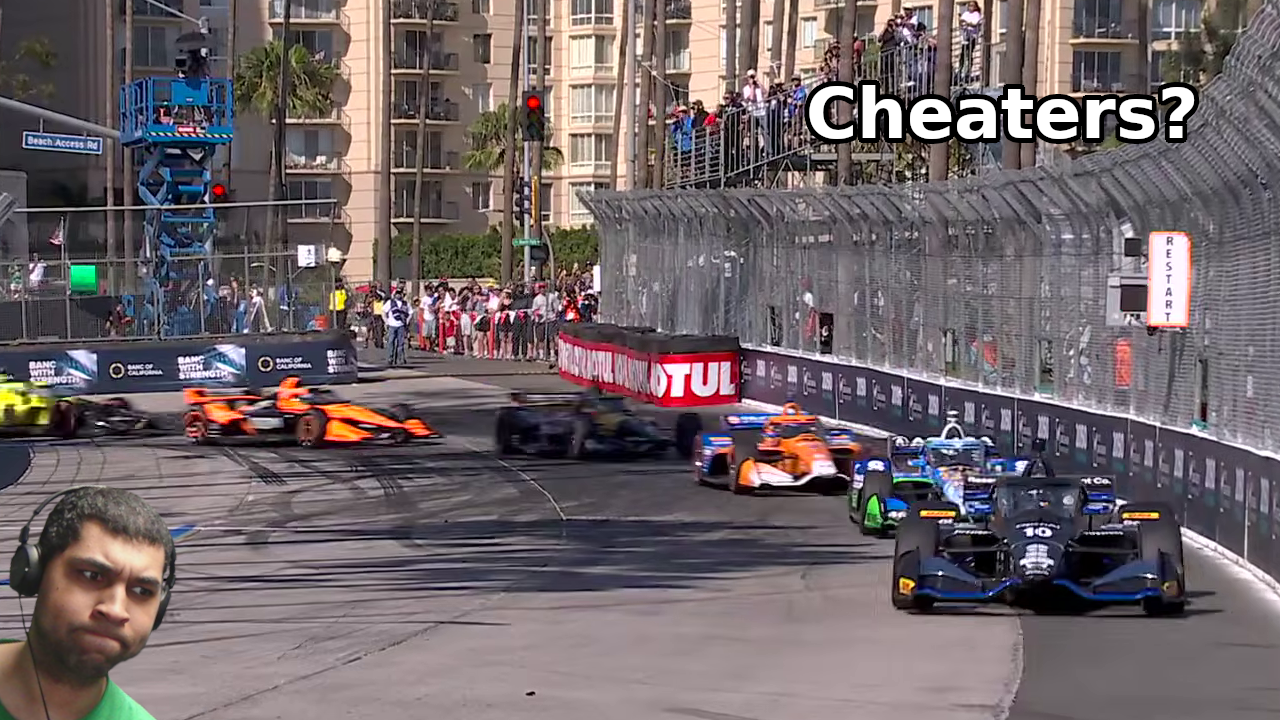
The IndyCar series has once again gotten itself into officiating drama, although this time, fortunately, it doesn't revolve around Team Penske. Due to an error, IndyCar's push-to-pass system was enabled when it shouldn't have been, and many drivers took advantage. Let's go over the situation and how it compares to the last time IndyCar had a scandal centered around the push-to-pass system.
If you aren't interested in reading my first push-to-pass rant, let me give you a refresher. Push-to-pass (or P2P) is a system that increases horsepower by increasing the boost pressure of the car's turbocharged engine. If none of that makes sense to you, the important part is that it makes the car faster at the push of a button. As the name implies, it's primarily designed to help with making passes, but there's no restriction on that, so it can be used to defend or even just get a little bit of extra lap time in general. Drivers get a pool of 150 or 200 seconds of total P2P time per race, depending on the track, and the button can be used for 15 or 20 second total bursts, respectively.
Back in 2024, Team Penske got into trouble for having modified software on their engine control units that allowed them to use P2P when they shouldn't have been able to. By rule, P2P is only enabled by race control after the conclusion of the first green flag lap after a start or restart (or, more accurately, once they reach the alternate start/finish line prior to the pit entrance on the restart lap), and the Penske software bypassed the restriction, allowing P2P at any time. Josef Newgarden and Scott McLaughlin utilized the P2P during the restricted period, while Will Power, notably, did not.
Fast-forward to Sunday's race in Long Beach. Due to a software glitch, P2P was enabled for all drivers prior to the designated point on lap 62, giving everyone a full lap of P2P when they shouldn't have had access. 12 of the 24 running cars utilized P2P during this time. After reviewing the situation, IndyCar's officiating team decided that there would be no penalties or adjustments post-race.
In retrospect, especially with my more measured take on the 2025 Indy 500 attenuator scandal, I think it's fair to say I was overly harsh on Penske in my initial take on the scandal. Since we know just how many drivers instinctively use the P2P button, even in situations where they should know it does nothing, it's possible that Newgarden and McLaughlin legitimately had no idea that the modified software was on their cars. My point should have been more focused on how Penske had access to the P2P telemetry and didn't self-report on the issue, but there's no point in dwelling on a mistake that Penske made over two years ago. At the end of the day, I was overly harsh on the drivers and even the team management, and I should have thought through the situation a bit more.
As for the current situation, IndyCar hasn't revealed exactly which drivers used P2P during the restricted lap, but they did reveal that the 66 of Marcus Armstrong and the 14 of Santino Ferrucci were two of them. While Armstrong did pass Ferrucci on the restart lap, apparently they both used an equal amount of P2P on the lap, and Armstrong ended up falling back and finishing behind Ferrucci anyway. No other passes were made on the extra P2P lap, so it didn't really affect the outcome of the race at all. Overall, a no-call seems like the correct decision, and this whole story does seem like something of a non-issue.
Still, no one hates a motorsport series more than its own fans, and with nothing else to talk about for the next three weeks, it's not a good look for IndyCar.