Jacen's Rants
An Ill-informed Supercars Parity Rant
April 12, 2026
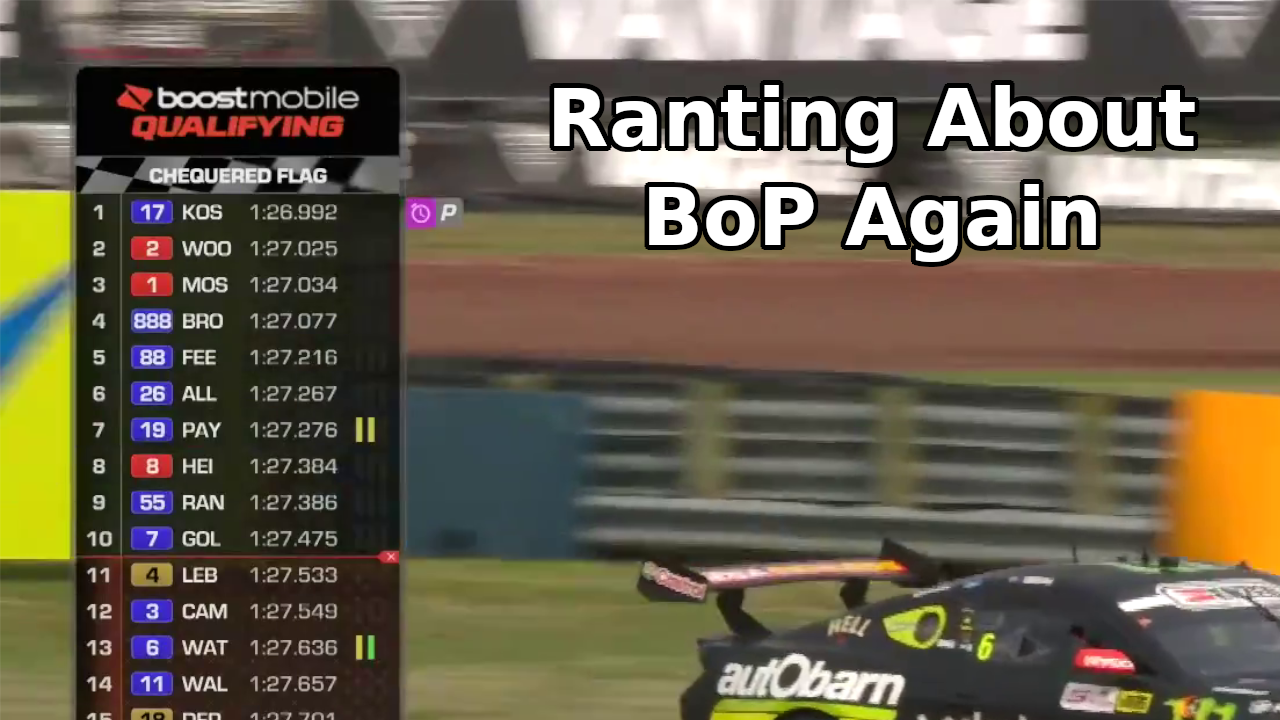
Due to time zones, I'm not able to watch Supercars as often as I would like. As a result, I'm not as familiar with team or driver performance as I would like, so take everything I say here with a grain of salt. With that said, based on what I saw this weekend in Taupō, something's not right with the Chevys.
After the Taupō round, Chevrolet and Toyota have both triggered the Supercars parity review system. While I unfortunately wasn't able to find much information on how the system actually works, the important part is that the trigger is entirely automatic, based on lap time data from the last six races. Only nine races into the season, it seems very early for this kind of investigation.
Balance of Performance (BoP) is a contentious subject in any motorsport where it's implemented, but it's a necessary evil in any multi-manufacturer series. Without it, you end up like Formula One, where the driver is irrelevant and the car is the only important factor. Close and exciting racing is a good thing for the fans, manufacturers, and sponsors, so there does need to be some form of parity to achieve that.
In their articles on the topic, both Speedcafe and V8 Sleuth harp on the difference between technical parity and sporting parity, such as what WEC and IMSA employ. To me, it seems very elitist and nitpicky to try to claim that the two are fundamentally different. Supercars' parity formula is nothing more than another form of BoP. The methods might be different, but the end goal is the same: to make sure all teams are competing on the most even playing field possible.
I think it's a bit laughable to say that Toyota is suffering from parity issues given that they've managed two podiums and a win in the past three races, and they currently lead the Jason Richards Trophy standings going into Christchurch. It should be expected that a brand-new manufacturer in the series is going to lag behind the established players, and the fact that they've managed a win after just nine races is arguably proof that parity is working exactly as designed for them. Hopefully any changes on their front are minor, because I really don't think they need them.
Most of the fan (and even some driver) discussion for the past couple of years has been about Chevy having advantageous parity over Ford, so it was interesting to me to hear Chevy complaining about parity and preparing for an update. Then, at Taupō, I saw a glimpse of just how out of it the Chevys were. In qualifying for the first race, they were completely locked out of the top 10, and they had only one representative in the shootout for race 2. Race 1 was the first time GM didn't have a car in the top 10 since 1990.
As expected in any BoP-related discussion, there are some theories going around about Chevy sandbagging in order to get a more favorable parity. Currently, Anton De Pasquale is the highest-placed Chevy driver, sitting 192 points behind the championship-leading Ford of Brodie Kostecki. In the teams' standings, Team 18 is 283 points behind Triple Eight. Even Toyota has bumped them out of the top 5 in the drivers' championship after Ryan Wood's win in the second Taupō race. We're only a quarter of the way through the season, but I still find it hard to believe that Chevy would dig themselves into this deep of a hole in the name of sandbagging.
Regardless, Supercars will take a look at the data and come to a decision on what the next step is. Before the season began, the teams were praising Supercars for how good the parity calculations were, but after seeing Chevy's dismal performance in Taupō, I have to wonder just how close the parity actually is.